Tropidoclonion lineatum
Scientific name. Tropidoclonion lineatum
Common Name. Lined Snake
General information. A non-venomous snake, Tropidoclonion lineatum will not bite humans, nor harm them, though it may put on an impressive threat display complete with a flattening of its head. Generally nocturnal, these snakes are active from late March to November and commonly feed on earthworms, sow bugs, in addition to a wide variety of insects.
Protected status. The Lined Snake is not a protected species in Texas and can be legally collected with a hunting license.
Diagnostic features. Undivided anal plate Keeled dorsal scales (19 rows near midbody) Usually six supralabials The pointed head of T. lineatum, usually no wider than its neck, is used to burrow while searching for its insect and earthworm prey
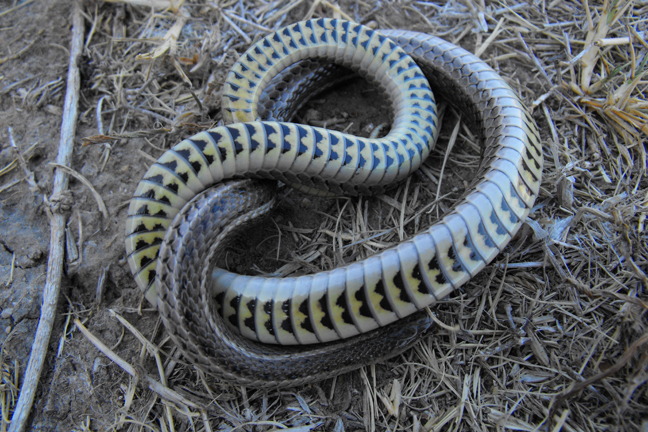
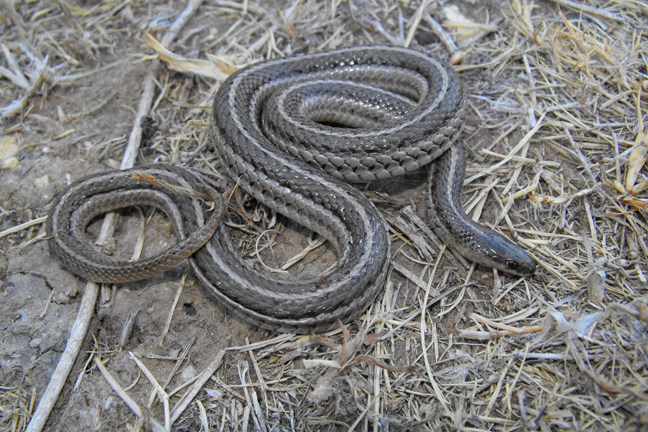
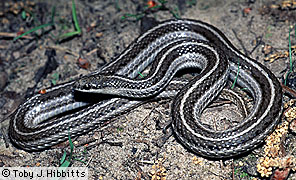
Coloration. Dull olive green dorsal background color Thin middorsal line that may be yellow, white or orange. Additional lateral lines found on the second and third dorsal scale rows. Double row of dark half moons found on the white ventral surface is this species’s most identifiable characteristic.
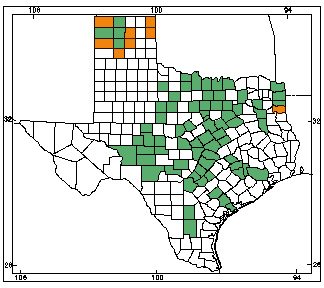
General distribution. The scattered distribution of Tropidoclonion lineatum is from southern Minnesota and South Dakota to central Texas, with isolated populations present in New Mexico, Colorado and the Texas Panhandle.
Texas distribution. In Texas, Tropidoclonion lineatum is found throughout much of the central third of the state, along with a disjunct Panhandle population.
Habitat. The Lined Snake is a common inhabitant of prairies and pasture lands, often found seeking refuge under flat stones. They can also be found in relatively urban areas, such as fields and open lots, as well as under debris piles and city dumps. The main characteristic these different habitats share is the presence of high amounts of water in the soil.
Reproduction. A live bearing snake, Tropidoclonion lineatum deposits its litter of 4-10 snakes during mid-August. The young snakes measure 7-13 cm (3-5 in) when born.
Size. Adult Tropidoclonion lineatum typically grow to 20-38 cm (8-15 in) in length.
Map. Orange counties indicate new county records since previous Herps of Texas update in 1998; all other colored counties reflect known distribution prior to 1998 for species and/or subspecies. Map is based on museum voucher specimens.