Trimorphodon vilkinsonii
Scientific name. Trimorphodon vilkinsonii
Common Name. Chihuahuan Lyresnake
General information. Almost strictly a nocturnal species, the Chihuahuan Lyresnake searches rock burrows and crevices for small mice, bats, and sleeping lizards. This species is rear-fanged and possesses venom used to immobilize its prey. Despite the presence of venom, this species is not considered dangerous to humans; rarely will lyresnakes even attempt to bite when handled.
Protected status. The Chihuahuan Lyresnake is listed as threatened by the Texas Parks and Wildlife Department and is protected in the state of Texas.
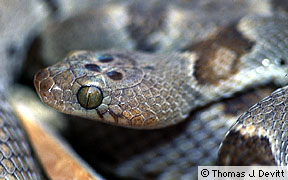
Diagnostic features. 23 rows of smooth dorsal scales at midbody Anal scale divided Only snake in Texas with lorilabial scale, present between loreal and upper labial scales Elliptical pupils
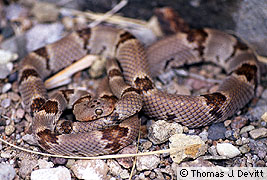
Coloration. Dorsal color gray Brown crossbands, averaging 21 on trunk, are saddle-shaped with light colored center Interspace distance typically twice width of crossbands Row of dark spots at dorsal/ventral scale contact Top of head with series of 1-3 brown spots or, rarely, incomplete V-shaped lyre.
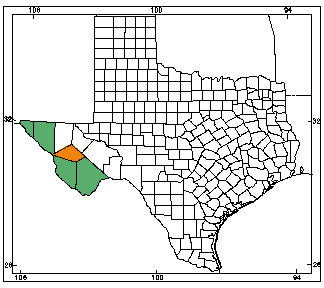
General distribution. In the United States, the distribution of Trimorphodon vilkinsonii is found across southern New Mexico, far west Texas (through Big Bend) and in Sonora and Chihuahua, Mexico.
Texas distribution. In Texas, Trimorphodon vilkinsonii is present along the Rio Grande from El Paso to Big Bend; individuals may be found some 50 miles from the river.
Habitat. The Chihuahuan Lyresnake is generally restricted to rocky habitats, particularly along hillsides and mountain slopes.
Reproduction. Little is known about reproduction in this species. Females likely lay eggs in early summer (single known clutch size is 6). Incubation around 75 days. Hatchlings measure 21.5 cm (8.5 in).
Size. Trimorphodon vilkinsonii typically measure 46-76 cm (18-30 in) as adults; record length is 104 cm (41 in).
Map. Orange counties indicate new county records since previous Herps of Texas update in 1998; all other colored counties reflect known distribution prior to 1998 for species and/or subspecies. Map is based on museum voucher specimens.