Terrapene ornata

Scientific name. Terrapene ornata
Common Name. Ornate Box Turtle
General information. A diurnal species, the Ornate Box Turtle spends its day alternating between basking, feeding, and seeking shelter from the heat of the day. Shelter may be burrows in sandy soils or under fallen vegetation. In the western half of Texas, activity is often increased following summer rains and thunderstorms. Insects make up the majority of the diet in ornate box turtles. This species is also known to eat carrion, bird eggs, small vertebrates and even fruit.
Protected status. The Ornate Box Turtle is not a protected species in Texas and can be legally collected with a hunting license.
Diagnostic features. High-domed carapace, not serrated posteriorly Four toes on rear feet. Transverse hinge across plastron. Upper jaw with downturned “beak” without notch.
Coloration. Carapace dark brown or reddish brown often with yellow middorsal stripe Conspicuous pattern of radiating yellow stripes on scutes, with dark seams. Plastron dark brown or tan; plastron with pattern of radiating lines. Skin brown with spots of yellow on limbs and head. Tail can have yellow stripe. Head can be greenish. Adult males with red iris; females with yellow-brown iris.
General distribution. In North America, Terrapene ornata is present across the south-central portion of the United States, and includes populations in Arizona, New Mexico and northern Mexico.
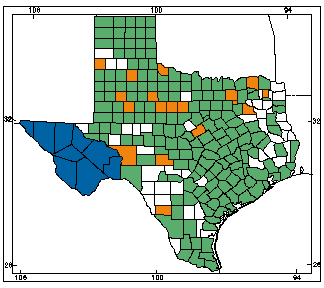
Texas distribution. In Texas, the two subspecies of Terrapene ornata, T. c. ornata and T. o. luteola, are found throughout most of the state, with T. o. luteola restricted to far west Texas.
Habitat. This box turtle species is generally restricted to the prairies devoid of trees and dominated by grass and low shrubs.
Reproduction. Nesting occurs in the late spring and summer. Clutch sizes range from 2-8 and two clutches may be laid each year. Incubation averages around 80 days.
Size. The carapace length of an adult Terrapene ornata typically measures between 10-13 cm (4-5 in).
Map. Orange counties indicate new county records since previous Herps of Texas update in 1998; all other colored counties reflect known distribution prior to 1998 for species and/or subspecies. Map is based on museum voucher specimens.