Tantilla gracilis
Scientific name. Tantilla gracilis
Common Name. Flat-headed Snake
General information. Tantilla gracilis feeds on arthropods, including centipedes, which also take advantage of the high moisture in such habitats. Tantilla gracilis is not a threat to humans who handle it, and captive snakes will often shove their heads into the folds of a captors hands looking for advantages to escape.
Protected status. The Flat-headed Snake is not a protected species in Texas and can be legally collected with a hunting license.
Diagnostic features. Smooth dorsal scales (in rows of 15 at midbody) Six supralabials Divided anal plate.
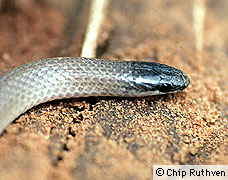
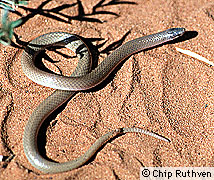
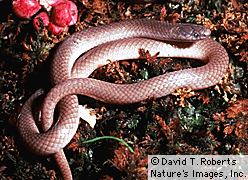
Coloration. Usually without a black cap on top of its head Tan or brown dorsal surface uninteruppted by dark pigment. Ventral surface is red or pink, which may actually be present on the supralabial and temporal scales on the head. Coloration of the head is generally darker than the rest of the body with certain individuals actually having a black cap present, though the cap does not contrast with the rest of the dorsum as strongly as seen in other species of Tantilla. The posterior edge of the black cap in T. gracilis is concave and does not extend below the corner of the mouth.
General distribution. The range of Tantilla gracilis extends from the lower Rio Grande valley northward to Kansas and Missouri.
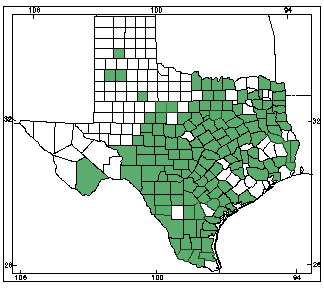
Texas distribution. In Texas, Tantilla gracilis is found throughout the central and eastern portions of the state, including a few isolated populations in the Panhandle.
Habitat. A common inhabitant of many gardens and urban areas, Tantilla gracilis is also found in piles of rocks and leaves in a variety of habitats; the common theme of these habitats is a high moisture content.
Reproduction. Flat-headed Snakes are egg layers, laying clutches of one to four eggs in the late spring with young snakes hatching in the summer, measuring 7.5-9 cm (3-3.5 in) in length.
Size. Tantilla gracilis is a smallish snake, with adults growing to 18-20 cm (7-8 in).
Map. Map is based on museum voucher specimens. Last updated 24 October 2013.