Storeria occipitomaculata

Scientific name. Storeria occipitomaculata
Common Name. Red-bellied Snake
General information. In the moist habitats where the Red-bellied Snake is found, there generally are many slugs and worms that make up the majority of its prey. Storeria occipitomaculata is non-venomous and poses no danger to humans handling it. It does have a remarkable bluff against would-be predators in that it plays dead, rolling onto its back and flattening portions of its body, feigning injury.
Protected status. The Red-bellied Snake is not a protected species in Texas and can be legally collected with a hunting license.
Diagnostic features. Divided anal plate Keeled dorsal scales in 15 rows at midbody.
Coloration. Belly is typically red, though some populations have orange or yellow bellies instead of red No black markings on its belly. Dorsum is a plain brown or reddish brown, with a few individuals having a series of four faint dark stripes. Narrow dark stripes may occasionally be reduced to a series of dark spots. Often three light colored spots along the nape of the neck, with the spots being fused together as a collar in some individuals. Additionally, there is a white spot found on the upper labials below the eye, for which the species name occipitomaculata is named.
General distribution. Storeria occipitomaculata is found across much of the eastern portions of the U.S., including the Midwestern states which drain into the Mississippi River valley.
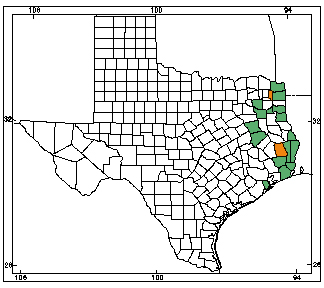
Texas distribution. The single subspecies of Storeria occipitomaculata found in Texas, S. o. obscura, is restricted to the piney woods along the extreme eastern edge of the state.
Habitat. The distribution of Storeria occipitomaculata is spotty in Texas, found only in the wetter woody areas in the eastern part of the state.
Reproduction. A live bearing snake, Storeria occipitomaculata bears up to 23 snakes per litter between the months of June and September, with the young usually measuring 6-10 cm (2.5-4 in).
Size. Adult Storeria occipitomaculata are relatively small snakes, typically measuring 20-25.5 cm (8-10 in) in length.
Map. Orange counties indicate new county records since previous Herps of Texas update in 1998; all other colored counties reflect known distribution prior to 1998 for species and/or subspecies. Map is based on museum voucher specimens.