Sistrurus tergeminus
Scientific name. Sistrurus tergeminus
Common Name. Western Massasauga
General information. Rattlesnakes are not generally aggressive and will likely flee if given a chance. They are of course venomous, and should be treated with great respect. Able to eat a wide variety of vertebrate prey, S. catenatus takes advantage of locally available food items such as mice, birds, lizards, toads, and even other snakes. Generally nocturnal animals, massasaugas can often be seen above ground following spring and summer rain storms.
Protected status. The Western Massasauga is not a protected species in Texas and can be legally collected with a hunting license.
Diagnostic features. Undivided anal scale Keeled scales in 25 dorsal scale rows in most Texas populations
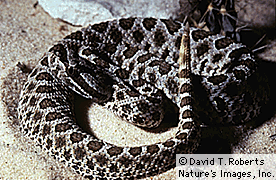
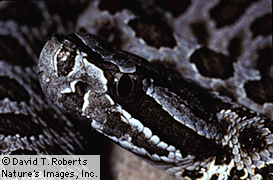
Coloration. Body has grey or tan dorsal background color Brown vertebral blotches that run the length of the body contrast sharply with the background color Vertebral blotches are closely spaced together and do not flatten into bands on the tail, as seen in Crotalus scutulatus and C. viridis An additional three rows of brown spots found laterally along the length of the body, however, the third or ventralmost series can be difficult to distinguish from the background Prominent chocolate colored stripe that runs through the eye and above the corner of the mouth; this dark ocular stripe has a thin, bright white line below it.
General distribution. The geographical range of Sisturus tergeminus is a patchy and which stretches across the United States and Canada. With its western extreme in southeastern Arizona, the massasauga is found through many of the midwestern states and is present as far east as portions of New York and adjacent Canada. Small, peripheral populations can also be found in northern Mexico.
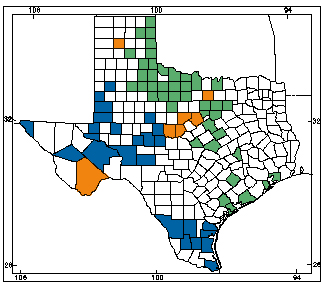
Texas distribution. Sistrurus tergeminus is present in northern portions of the Trans-Pecos and the Permian Basin region, through the remaining vestiges of prairie along the Gulf Coast, central Texas, and the eastern Panhandle and into south Texas.
Habitat. The habitat of S. t. tergeminus ranges from flat grasslands to low rocky hillsides, whereas S. t. edwardsii is restricted to the low, flat grasslands.
Reproduction. Breeding occurs in the spring, with an average of eight live young born during the summer months of July and August. The neonates measure between 18-23 cm (7-9 in), and often have a pinkish belly.
Size. Large adults up to 66 cm (26 in); record length for S. t. tergeminus is more than 88 cm (34 in), whereas record length for S. t. edwardsii is only 54 cm (21 in).
Map. Orange counties indicate new county records since previous Herps of Texas update in 1998; all other colored counties reflect known distribution prior to 1998 for species and/or subspecies. Map is based on museum voucher specimens.