Pseudemys texana

Scientific name. Pseudemys texana
Common Name. Texas Cooter
General information. This turtle species is strictly diurnal, spending much of the daylight hours basking on logs and rocks. Food items include a wide variety of invertebrates, including crayfish, snails, and both terrestrial and aquatic insects.
Protected status. The Texas Cooter is not a protected species in Texas and can be legally collected with a hunting license.
Diagnostic features. Carapace is oval, flattened, with serrated posterior edge Unhinged plastron. Medial notch on upper jaw with adjacent tooth-like cusps. Webbed feet. Males with longer fingernails on forelimbs than females
Coloration. Carapace olive with blotches of alternating yellow and black. 2nd costal scute with five or six distinct concentric whorls with dark centers. Plastron yellow with pigment along seams, fading with age; plastron pigment present along anterior seams in adults. Skin black with white or yellow stripes present on neck, legs, and tail. Head markings variable, combination of yellow stripes broken into smaller spots and dashes. Postorbital stripe and vertical bar behind jaw articulation often present; lateral head stripes curve above vertical bar. Older individuals (especially males and large females) with mottled shells, limbs, and head and obscured patterns.
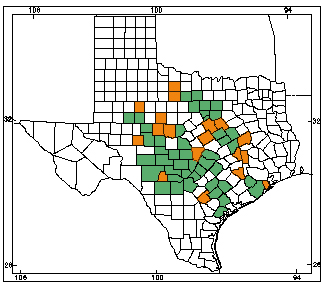
General distribution. In North America, Pseudemys texana is found exclusively in Texas, from central Texas to the Gulf Coast.
Texas distribution. In Texas, the endemic Pseudemys texana is found in the Colorado, Brazos, Guadalupe, and San Antonio River drainages.
Habitat. The Texas Cooter is found in streams as well as lakes and other man-made impoundments.
Reproduction. Nesting in May and June. Females lay clutches of 4-19 eggs.
Size. Adult Pseudemys texana reach carapace lengths between 18-25 cm (7-10 in).
Map. Orange counties indicate new county records since previous Herps of Texas update in 1998; all other colored counties reflect known distribution prior to 1998 for species and/or subspecies. Map is based on museum voucher specimens.