Pseudacris crucifer
Scientific name. Pseudacris crucifer
Common Name. Spring Peeper
General information. Pseudacris crucifer is nocturnal and is rarely seen except during breeding season; P. crucifer hibernates in very cold weather.
Protected status. The Spring Peeper is not a protected species in Texas and can be legally collected with a hunting license.
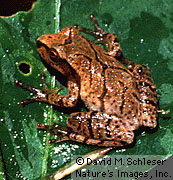
Diagnostic features. Small, slender body with large toe pads and unwebbed toes.
Coloration. Dorsal color varies from yellow, brown, olive, to gray Dark cross on dorsal surface in shape of an ‘X’ Plain ventral surface Females are generally lighter in coloration.
General distribution. In North America, Pseudacris crucifer is found from the southern parts of eastern Canada, south to the Gulf of Mexico.
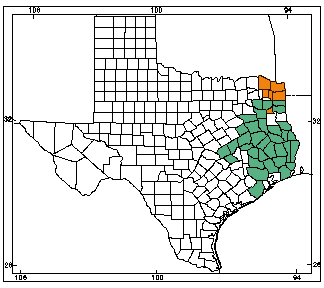
Texas distribution. The single subspecies of Pseudacris crucifer found in Texas, P. c. crucifer, is restricted to the eastern quarter of the state.
Habitat. Pseudacris crucifer prefers woodland areas and areas of brushy growth near small temporary ponds.
Reproduction. Breeding occurs from November to February, depending on the temperature. Single eggs are laid among underwater vegetation.
Size. Pseudacris crucifer reaches an adult length between 3-5 cm (1.25-2 in).
Calls.
Map. Orange counties indicate new county records since previous Herps of Texas update in 1998; all other colored counties reflect known distribution prior to 1998 for species and/or subspecies. Map is based on museum voucher specimens.