Nerodia paucimaculata

Scientific name. Nerodia paucimaculata
Common Name. Concho Watersnake
General information. A non-venomous snake, Nerodia paucimaculata is primarily diurnal, actively foraging for food (mainly fish) during the morning and early afternoon. Rarely found more than 2 meters (6.5 ft) from the water, Concho watersnakes bask over the water, allowing for a quick escape when threatened by would-be attackers.
Protected status. The Concho Watersnake is considered an endangered species by the Texas Parks and Wildlife Department and is fully protected by the state. Additional protection has been afforded to this species as the U.S. Fish and Wildlife Service considers the Concho watersnake to be a federally threatened species.
Diagnostic features. Divided anal scale Keeled dorsal scales in 21-23 rows near midbody. A single row of scales separate the posterior chinshields
Coloration. Dorsal ground color is light tan with reddish tint Four faint rows of dorsal blotches Orangish or pink belly is either lightly marked with dark pigment or immaculate. If faint belly markings are present, they are found on the margins of the ventral scales.
General distribution. The entire range of Nerodia paucimaculata is found in Texas.
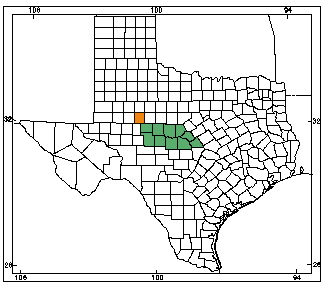
Texas distribution. Nerodia paucimaculata is only found along the Concho and Colorado Rivers in west-central Texas.
Habitat. Unfortunately, damming of the Concho and Colorado Rivers has flooded much of the essential habitat of this snake: rocky shorelines. Additional habitat of the Concho Watersnake has been altered due to increased vegetation and sedimentation. Much of the increased vegetation is caused by introduction of non-native species, with the primary culprit being salt cedar. Further construction of dams threaten over 20% of the remaining habitat for these snakes.
Reproduction. Little is known about the reproductive natural history of this species, other than it is viviparous.
Size. Adult Nerodia paucimaculata typically measure 51-76 cm (20-30 in) in length
Map. Orange counties indicate new county records since previous Herps of Texas update in 1998; all other colored counties reflect known distribution prior to 1998 for species and/or subspecies. Map is based on museum voucher specimens.