Nerodia clarkii

Scientific name. Nerodia clarkii
Common Name. Saltmarsh Snake
General information. Being able to live in a harsh salty environment makes Nerodia clarkii atypical among the snakes of Texas. Drinking no salt water during its existence in the marshes, it aquires all of its water from its prey. These prey species include frogs and a wide variety of invertebrates, including shrimp, crabs, and crayfish. This non-venomous snake, also found on many of the grass-lined coastal barrier islands, is not considered aggressive, though it will definitely bite without hesitation if handled.
Protected status. The Saltmarsh Snake is not a protected species in Texas and can be legally collected with a hunting license.
Diagnostic features. Divided anal plate 21-23 keeled dorsal scale rows near midbody.
Coloration. One of the most distinctly patterned snakes in all of Texas, with its four dark longitudinal stripes contrasting greatly with its light gray colored background. The upper two stripes are generally black with the two stripes found lower on the body either tan or light brown. The belly is red or brown, with a median row of light spots found on the ventrals. Some individuals may have three rows of these light spots on the belly.
General distribution. Only found in the U.S., Nerodia clarkii is found along much of the Texas coastal wetland, as well as along the entire coastline of Louisiana, Mississippi, Alabama, and the majority of the Florida coast.
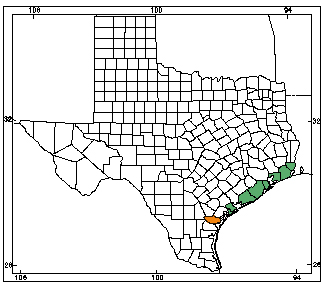
Texas distribution. In Texas, Nerodia clarkii is found along the coastline, from Corpus Christi eastward to the Texas-Louisiana border.
Habitat. The Saltmarsh Snake is aptly named as this snake is rarely found in fresh water environments, spending its entire life among the salt-grass marshes of the tidal wetlands.
Reproduction. As many as 44 juvenile snakes may be born in a single litter. Nerodia clarkii is viviparous, giving birth to live young, which may be as long as 24.5 cm (9.5 in) when born.
Size. Not a large snake, Nerodia clarkii typically measures between 38-76 cm (15-30 in).
Map. Orange counties indicate new county records since previous Herps of Texas update in 1998; all other colored counties reflect known distribution prior to 1998 for species and/or subspecies. Map is based on museum voucher specimens.