Macrochelys temminckii

Scientific name. Macrochelys temminckii
Common Name. Alligator Snapping Turtle
General information. This turtle species spends much of its underwater; it has only been observed basking above water once. The Alligator Snapping Turtle can not stay underwater as long as other aquatic turtle species, needing to surface at least once an hour during periods of activity. This is an omnivorous species, feeding on many live or dead vertebrate or invertebrate animals. Additionally, roots and fruit are found to be important components of many alligator snapping turtles living in smaller streams and rivers. Other turtles species are included on their menu.
Protected status. The Alligator Snapping Turtle is listed as threatened by the Texas Parks and Wildlife Department and is protected in the state of Texas.
Diagnostic features. Carapace with three prominent keels and additional row of scutes (supramarginal) along each side Carapace serrated posteriorly Bridge is small and unhinged plastron is extremely reduced. Tail roughly equivalent length of carapace. Huge head with hooked beak, with eyes placed laterally on head (not visible from dorsal view). Worm-like pink process on tongue used for luring.
Coloration. Carapace dark (black to brown); plastron grayish brown Skin brown to gray.
General distribution. In North America, the distribution of Macrochelys temminckii includes much of the Mississippi River Valley (known historically as far north as Iowa and Illinois) and adjacent drainages of the southeastern United States.
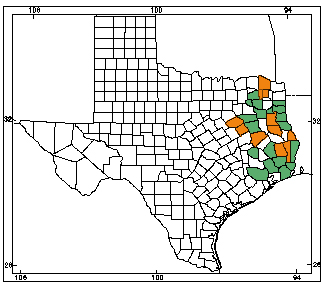
Texas distribution. In Texas, Macrochelys temminckii is restricted to wetter locations of east Texas.
Habitat. The Alligator Snapping Turtle frequents the bottom of rivers, lakes, sloughs, swamps and bayous.
Reproduction. Nesting season is May to July. Clutch sizes are 9-44 eggs. Nests are laid during the day with incubation lasting 70-105 days.
Size. Macrochelys temminckii is the largest freshwater turtle in North America, reaching carapace lengths of 80 cm (32 cm).
Map. Orange counties indicate new county records since previous Herps of Texas update in 1998; all other colored counties reflect known distribution prior to 1998 for species and/or subspecies. Map is based on museum voucher specimens.