Leptodeira septentrionalis

Scientific name. Leptodeira septentrionalis
Common Name. Northern Cat-eyed Snake
General information. Hunting at night or in the extremely dense foliage of south Texas, L. septentrionalis feeds primarily on frogs and toads along water courses, with records of rodents, lizards, and other snakes found in the literature. This is a mildly venomous (rear-fanged) species that envenomates its prey by way of enlarged teeth found in the rear of the mouth; the venom is used for immobilization of prey items, not to kill them. Leptodeira are known to be semiarboreal as well, searching for its prey in the trees. As much of its habitat is disappearing from south Texas, L. septentrionalis is thought to be a rare snake in the state.
Protected status. As a consequence of its dwindling habitat, L. septentrionalis is listed as an threatened species by the Texas Parks and Wildlife Department and is protected by the state of Texas.
Diagnostic features. Divided anal plate Smooth dorsal scales (some with apical pits), and 21-23 dorsal scale rows at midbody The cat-eyed snake is characterized by its bulging and large, golden eyes with vertical elliptical pupils, which allude to its nocturnal behavior. Cat-eyed snakes also have a large, broad head, in comparison with their narrow neck and body
Coloration. A dorsal ground color of cream to dark tan, with a series of dark brown or black crossbands that saddle the body, not intruding onto the belly. The chin and throat are pale colored, deepening to orange at midbody and a salmon under the tail. The belly scales also have a darker posterior border.
General distribution. Leptodeira septentrionalis is found from the southern tip of Texas, along the Gulf Coast in Mexico, through Central America, into northern South America.
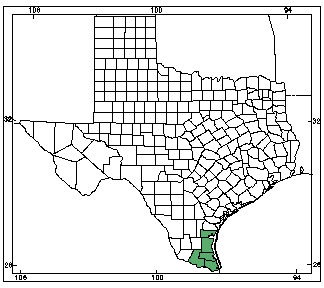
Texas distribution. The only subspecies of Leptodeira found in the state, L. s. septentrionalis, is restricted to a handful of counties, mostly along the Rio Grande Valley in the few remaining stretches of habitat remaining.
Habitat. The Northern Cat-eyed Snake is found only in the extreme southern portions of the state in thornscrub and subtropical habitats.
Reproduction. Females lay clutches of eggs, average of 7 eggs, in the spring with an incubation period of two and a half months. Hatchlings are typically 20-23 cm (8-9 in) upon emergence from their eggs.
Size. Northern Cat-eyed Snakes, as adults measuring 45.5-61 cm (18-24 in), occassionally reaching lengths of over 91 cm (3 ft).
Map. NA