Holbrookia maculata

Scientific name. Holbrookia maculata
Common Name. Common Lesser Earless Lizard
General information. Holbrookia maculata is an active, diurnal lizard. They shelter in burrows and cover themselves with sand to hide. They feed on spiders and insects.
Protected status. The Common Lesser Earless Lizard is not a protected species in Texas and can be legally collected with a hunting license.
Diagnostic features. Two throat folds (one weak) No external ear openings.
Coloration. The three subspecies of Holbrookia maculata found in Texas are distinguished by their color and pattern Two black diagonal marks on the sides posterior to the forelegs; diagonal marks rimmed in blue on males, less distinct on females . No markings on ventral surface of tail.
General distribution. In North America, Holbrookia maculata has a broad range, from southern South Dakota to Texas and Arizona and into central Mexico.
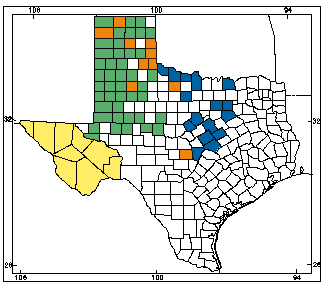
Texas distribution. In Texas, the three subspecies of Holbrookia maculata are present in north Texas, the Panhandle, and west Texas.
Habitat. Holbrookia maculata prefers sandy desert grasslands, areas with sparse vegetation, prairies, farmlands, and dry streambeds.
Reproduction. Breeding takes place in spring and early summer. Eggs may be laid from May to August, with an average of 5 eggs per clutch.
Size. Holbrookia maculata can grow to lengths of 11-15 cm (4.5-6 in), including tail.
Map. Orange counties indicate new county records since previous Herps of Texas update in 1998; all other colored counties reflect known distribution prior to 1998 for species and/or subspecies. Map is based on museum voucher specimens.