Heterodon nasicus
Scientific name. Heterodon nasicus
Common Name. Plains Hog-nosed Snake
General information. Hog-nosed snakes are so named because of their upturned keeled rostral scale. This modification allows them to burrow easily into the soil, either to seek shelter or to seek out their prey. Plains Hog-nosed Snakes are rear-fanged, that is they are venomous, though they pose little threat to humans, even when handled, because of this species reluctance to bite. Occasional bites to humans do occur, usually when a person has been handling toads prior to handling a hog-nosed snake. Human reactions to hog-nosed snake bites can include large amounts of swelling, depending on the duration of the bite. Their venom, though mild to human, is highly effective against its usual prey of frogs, toads, and occassionaly lizards. Young snakes may ingest crickets and other insects. The venom is delivered to the prey by way of enlarged teeth in the rear of the mouth through a chewing motion. Western hog-nosed snakes feed mainly on amphibians and lizards, though they will eat other snakes, small mammals, and occasional birds. Hog-nosed snakes are active in the morning and around dusk during the warmer parts of the year, burrowing in sandy soils during the winter.
Protected status. The Plains Hog-nosed Snake is not a protected species in Texas and can be legally collected with a hunting license.
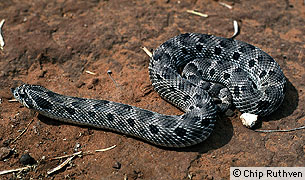
Diagnostic features. Divided anal plate Keeled dorsal scales in rows of 23 at midbody Nine or more azygous scales
Coloration. Dorsal ground color is light tan or buff, with a series of large, elliptical blotches down the spine A series of small brown spots also runs the length of the body on each side of the body. The number of azygous scales found behind the upturned rostral on the head can help distinguish this species from H. kennerlyi, with 6 or fewer in H. kennerlyi. The belly, especially the tail, is black, with patches of white or yellow present.
General distribution. Heterodon nasicus is found from Alberta, Canada, through the midwest and plains sections of the U.S., into Texas and portions of northern and central Mexico.
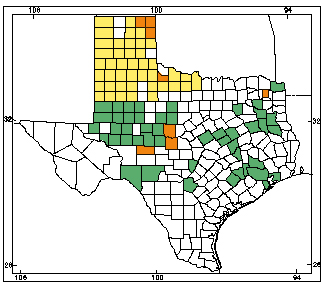
Texas distribution. In Texas, Heterodon nasicus can be found throughout many areas of the state, though they are largely absent from the Edwards Plateau and far east Texas, as well as the Rio Grande Valley.
Habitat. Plains Hog-nosed Snakes inhabit a wide variety of areas, including but not limited to flat grasslands, rocky arid lands and coastal barrier islands.
Reproduction. Plains Hog-nosed Snakes are egg-bearing, breeding in alternate years. Clutches range from 4-23 eggs, and are laid in the summer months. Incubation is about two months with hatchlings measuring 15-19 cm (6-7.5 in) in length.
Size. Adult Heterodon nasicus are typically 38-63.5 cm (15-25 in) in length.
Map. Orange counties indicate new county records since previous Herps of Texas update in 1998; all other colored counties reflect known distribution prior to 1998 for species and/or subspecies. Map is based on museum voucher specimens.