Graptemys ouachitensis

Scientific name. Graptemys ouachitensis
Common Name. Ouachita Map Turtle
General information. This turtle species spends much of its day basking on logs, rocks, or other available basking sites. An omnivore, this map turtle grazes on algae and aquatic vegetation as well as various invertebrates (insects and crayfish). Males and juveniles are more carnivorous than females.
Protected status. The Ouachita Map Turtle is not a protected species in Texas and can be legally collected with a hunting license.
Diagnostic features. Flattened, elliptical carapace with serrated posterior edge and vertebral keel of spine-like projections; serrated edge and projections becoming less distinct with age. Plastron unhinged. Webbed feet. Head narrow with no medial notch or hook on upper jaw. Males with longer fingernails on forelimbs than females.
Coloration. Carapace brown to dark green Plastron is yellow/cream and can be pigmented extensively in juveniles, pigment fades in adults. Yellow markings and dark blotches on each pleural scute; marginal surfaces with yellow eye spots at seam. Skin olive or brown; yellow stripes present on legs and tail. One to nine yellow neck markings contacting eye. Transverse yellow chin bars. Yellow crescent behind eye (also can be square/rectangular/oval) and two yellow spots below eye.
General distribution. In North America, Graptemys ouachitensis is found along the Mississippi River drainage, from Illinois and Missouri to Texas, Louisiana, and Mississippi.
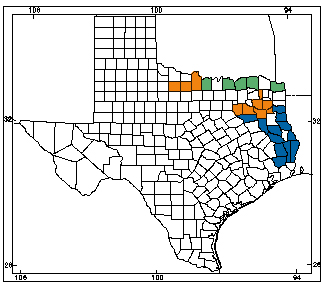
Texas distribution. In Texas, the two subspecies of Graptemys ouachitensis , G. o. ouachitensis and G. o. sabinensis are restricted to the Red River and Sabine River drainages in the northeastern portion of the state.
Habitat. The Ouachita Map Turtle is found in large rivers as well as lakes and river-bottom swamps.
Reproduction. Females can lay up to three clutches of eggs each year, each clutch consisting of 6-15 eggs. Nesting season is May to July. Incubation is 50 to 80 days.
Size. Graptemys ouachitensis exhibits sexual dimorphism, with males reaching smaller adult lengths (14 cm; 5.5 in) than females (24 cm; 9.5 in).
Map. Orange counties indicate new county records since previous Herps of Texas update in 1998; all other colored counties reflect known distribution prior to 1998 for species and/or subspecies. Map is based on museum voucher specimens.