Eretmochelys imbricata

Scientific name. Eretmochelys imbricata
Common Name. Hawksbill Sea Turtle
General information. A diurnal species, the Hawksbill Sea Turtle spends the day feeding and resting around coral reefs. This species is an omnivore, but with a major preference for sponges.
Protected status. The Hawksbill Sea Turtle is considered an endangered species by the Texas Parks and Wildlife Department and is fully protected by the state. Additional protection has been afforded to this species as the U.S. Fish and Wildlife Service considers the hawksbill seaturtle to be a federally endangered species.
Diagnostic features. Broad, long shield-shaped carapace with four pair of pleural scutes (the first pair not in contact with 1st cervical scute) Scutes are overlapping in juveniles. Keel present on last four vertebral scutes. Posterior edge of carapace serrated. Unhinged plastron that may have two longitudinal ridges that are lost with age in addition to dark blotches Four poreless inframarginals along bridge. Head with two pairs of prefrontals and four postocular scales. Snout, like raptor, is long and narrow (beak-like), without a notch. Paddle-like front limbs with two claws.
Coloration. Carapace dark green to brown; tortoise-shell pattern in juveniles Plastron yellow; bridge yellow. Skin often brown, gray or black and is darker dorsally (with yellow or cream color ventrally). Head black to brown with scales lighter towards their edge. Chin and throat yellow and neck dark.
General distribution. In North America, Eretmochelys imbricata is restricted to the warmer waters of the Pacific and Atlantic Oceans, from southern California to Mexico, and southern New England to the Caribbean.
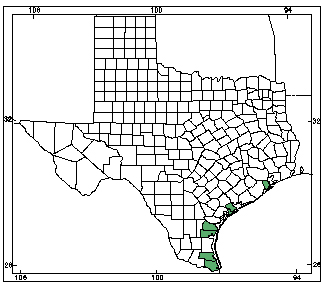
Texas distribution. In Texas, the single subspecies of Eretmochelys imbricata found in Texas, E. i. imbricata, is known from several localities along the Texas Gulf Coast.
Habitat. The Hawksbill Sea Turtle is frequently found around reefs and rocky habitats in shallow waters.
Reproduction. Nesting in hawksbill seaturtles peaks between May and July. Females may only lay eggs every two or three years, having up to four clutches during that year. Clutch size averages 160 eggs and incubation is 60-70 days.
Size. Eretmochelys imbricata reach adult lengths of 75-90 cm (30-36 in).
Map. Orange counties indicate new county records since previous Herps of Texas update in 1998; all other colored counties reflect known distribution prior to 1998 for species and/or subspecies. Map is based on museum voucher specimens.