Diadophis punctatus
Scientific name. Diadophis punctatus
Common Name. Ring-necked Snake
General information. Diadophis punctatus are not dangerous to humans, being too small to bite a person and are not known to even try when handled. They are venomous to their prey, however, as they are able to introduce venomous secretions into their prey by chewing on the prey item. Prey items are typically reptilian, either small snakes or lizards, but insects and earthworms are also eaten. In areas of abundant salamanders, they too are consumed by ring-necked snakes.
Protected status. The Ring-necked Snake is not a protected species in Texas and can be legally collected with a hunting license.
Diagnostic features. Three subspecies in the state are distinguished from each other by presence/absence of a light-colored collar, number of dorsal scale rows at midbody, and pigmentation pattern (if any) on the belly of the snake. All ringneck subspecies have smooth scales and a divided anal plate.
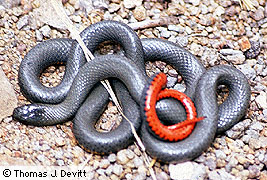
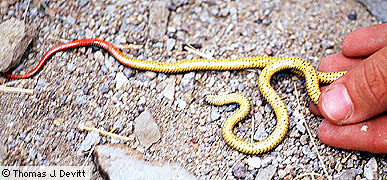
Coloration. Called “ring-necked” because of light colored (cream) collar just behind the head Entire dorsal surface, save light collar, is a plain olive or gray color Belly is yellow or orange, with color intensity highest on the underside of the tail (caudal scales), which is often brick red or orange.
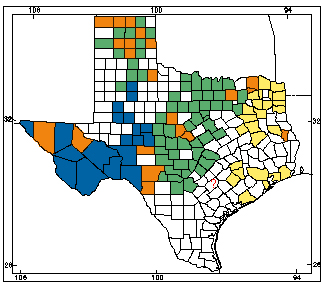
General distribution. There are 12 subspecies of Diadophis punctatus recognized in North America. They are found throughout much of the U.S., save the upper midwestern states, as well as Colorado, Wyoming and Montana. Diadophis punctatus also extends well into Mexico, along each side of the Sierra Madre Oriental.
Texas distribution. In Texas, Diadophis punctatus is found everywhere in the state except south Texas (south of San Antonio).
Habitat. The Ring-necked Snake is an attractive olive colored snake often found seeking refuge under rocks and logs. Much more common in areas of higher moisture, they are found sporadically through the drier areas of Texas, including some of the moister areas of the Chihuahuan Desert. In the east, ring-necked snakes are much more common than in the west and more than two or three snakes will often be found together under stones or logs in a wide variety of moist habitats. In the west, ring-necked snakes are restricted to the moister areas of available habitat, seeking refuge in river bottoms, rock crevices or under fallen yucca logs.
Reproduction. Egg laying occurs in June or July when clutches of one to eight eggs are deposited. Young can emerge as soon as five weeks later, measuring 9-14 cm (3.5-5.5 in) in length.
Size. Adult Ring-necked Snakes found in Texas, but outside of the Trans-Pecos, typically measure 25.5-35.5 cm (10-14 in) in length; Diadophis p. regalis, is much larger than the other two Texas subspecies, with adults averaging 38-46 cm (15-18 in) in length.
Map. Orange counties indicate new county records since previous Herps of Texas update in 1998; all other colored counties reflect known distribution prior to 1998 for species and/or subspecies. Map is based on museum voucher specimens.