Aspidoscelis scalaris
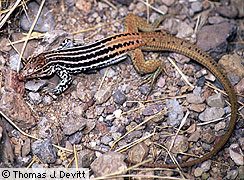
Scientific name. Aspidoscelis scalaris
Common Name. Plateau Spotted Whiptail
General information. This diurnal lizard forages for insects among vegetation clumps and leaf litter, overturning rocks and sticks with its snout. Its movements are slow and deliberate.
Protected status. The Plateau Spotted Whiptail is not a protected species in Texas and can be legally collected with a hunting license.
Diagnostic features. Slender lizard with comparatively long tail, almost 3 times the head-body length. Small, granular dorsal scales with enlarged scales in front of throat fold and on back of forelimbs Belly with 8 rows of large, rectangular scales.
Coloration. Dorsal ground color dark green, dark brown, or black. Dorsal pattern consists of 6-7 light stripes that run from the head to the hips; white spots occur between the stripes. Ventral surface white or pale blue. Tail at base and hips are rust colored, then tail turns brown or gray. Species is dimorphic with adult females having an orange throat.
General distribution. In North America, Aspidoscelis scalaris has a small range that includes parts of Texas and Mexico.
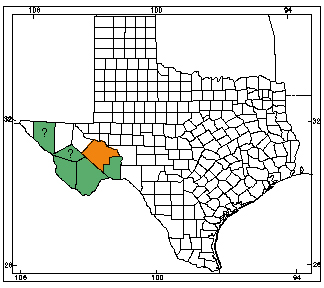
Texas distribution. In Texas, Aspidoscelis scalaris is found across six counties in the western Trans-Pecos.
Habitat. Aspidoscelis scalaris prefers rocky areas with little vegetation in canyons, desert foothills, or mountains.
Reproduction. Breeding takes place in late spring. Females lay egg clutches in midsummer. Hatchlings with bright blue tail.
Size. Aspidoscelis scalaris reach adult total lengths of 20-31 cm (8-12.5 in).
Map. Orange counties indicate new county records since previous Herps of Texas update in 1998; all other colored counties reflect known distribution prior to 1998 for species and/or subspecies. Map is based on museum voucher specimens.