Aspidoscelis laredoensis
Scientific name. Aspidoscelis laredoensis
Common Name. Laredo Striped Whiptail
General information. This diurnal lizard forages for insects among vegetation clumps and leaf litter.
Protected status. The Laredo Striped Whiptail is not a protected species in Texas and can be legally collected with a hunting license.
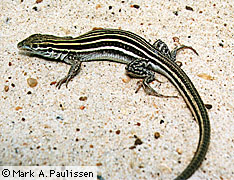
Diagnostic features. Slender lizard Small, granular dorsal scales with enlarged scales on back of forelimbs. Belly with 8 rows of large, rectangular scales
Coloration. Dorsal ground color dark green or dark brown. Dorsal pattern consists of 7 light stripes that run from the head onto the tail; light spots may occur between the stripes. The middorsal stripe is narrow and may not be continuous. Ventral surface white Tail greenish brown with light tan underside.
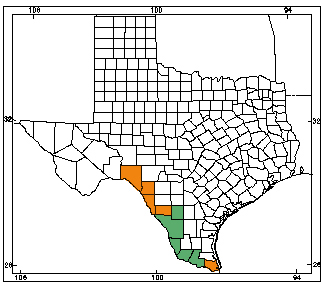
General distribution. In North America, Aspidoscelis laredoensis has a small and narrow range in the lower Rio Grande Valley.
Texas distribution. In Texas, Aspidoscelis laredoensis is restricted to the lower Rio Grande Valley from Val Verde County to Cameron County.
Habitat. Aspidoscelis laredoensis is common in disturbed areas with sandy or sandy-loam soil and weedy vegetation. Dirt roadsides, edges of cultivated fields, abandoned lots, and heavily grazed pastures in semi-arid environments are preferred.
Reproduction. Aspidoscelis laredoensis is an all-female species; there are no males in this species. Reproduction occurs through parthenogenesis. One to four unfertilized eggs are laid in midsummer. Hatchlings appear in July and August. Hatchlings have a light, sky-blue tail, but otherwise resemble the adults.
Size. Aspidoscelis laredoensis can grow to a maximum total length of 15- 28 cm(6-11 in).
Map. Orange counties indicate new county records since previous Herps of Texas update in 1998; all other colored counties reflect known distribution prior to 1998 for species and/or subspecies. Map is based on museum voucher specimens.