Aspidoscelis inornata

Scientific name. Aspidoscelis inornata
Common Name. Little Striped Whiptail
General information. This diurnal lizard forages for large insects and spiders. Aspidoscelis inornata is wary of being approached, and will hide under vegetation or in a burrow if threatened.
Protected status. The Little Striped Whiptail is not a protected species in Texas and can be legally collected with a hunting license.
Diagnostic features. Slender lizard with a comparatively long tail, about 3 times the head-body length Small, granular dorsal scales with enlarged scales on back of forelimbs and along the front edge of throat fold Belly with 8 rows of large, rectangular scales
Coloration. Dorsal ground color dark gray or black. Dorsal pattern consists of 6-8 light stripes that run from the head onto the tail; no spots occur between the stripes. Blue coloration on sides of head Ventral surface blue, though adult males have much deeper blue on ventral surface than females.
General distribution. In North America, Aspidoscelis inornata is found in west Texas and adjacent Mexico and New Mexico.
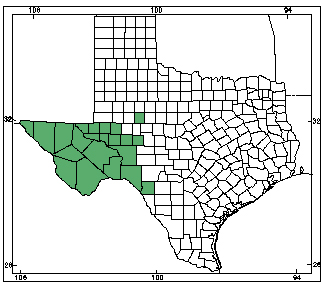
Texas distribution. A single subspecies of Aspidoscelis inornata, A. i. heptagramma, is found in Texas, present throughout the western portion of the state.
Habitat. Aspidoscelis inornata can be seen rocky slopes or grassy flatlands in arid and semi-arid environments. It is sometimes seen in sandy soil environments.
Reproduction. Breeding occurs in the spring and eggs are laid from May to July. Females lay 2-4 eggs. Hatchlings have a pale blue venter.
Size. Adult Aspidoscelis inornata grow to 11-24 cm (6.5-9.5 in).
Map. Orange counties indicate new county records since previous Herps of Texas update in 1998; all other colored counties reflect known distribution prior to 1998 for species and/or subspecies. Map is based on museum voucher specimens.