Agkistrodon contortrix
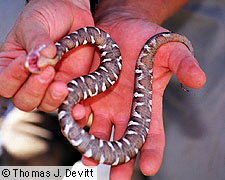
Scientific name. Agkistrodon contortrix
Common Name. Copperhead
General information. Copperheads are venomous, and are therefore highly dangerous if approached or handled. They are not generally aggressive and will most likely flee any confrontation if given a chance to retreat. Called copperheads because of their distinctly colored heads, the subspecies of A. contortrix make use of their colorations by living in partly shaded habitats. Hiding in leaf piles beneath trees, or alongside logs and stones in wooded forests, the copperhead is able to elude predators because of its camouflage. This cryptic behavior also allows copperheads to strike out at unsuspecting prey. The light grey or olive colored tail of the copperhead is used to lure prey to within striking distance. Prey includes rodents, birds, lizards, frogs and other amphibian species. Being nocturnal during the hotter summer months, A. contortrix is active during the day only during the cooler spring and fall months.
Protected status. The Copperhead is not a protected species in Texas and can be legally collected with a hunting license.
Diagnostic features. Undivided anal scale Dorsal scales keeled, in rows of 21-25 near midbody Distinctions between the three subspecies are based on color variations, yet some of these variations have been shown to be variable over the range of a single subspecies
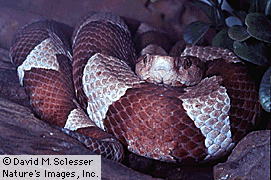
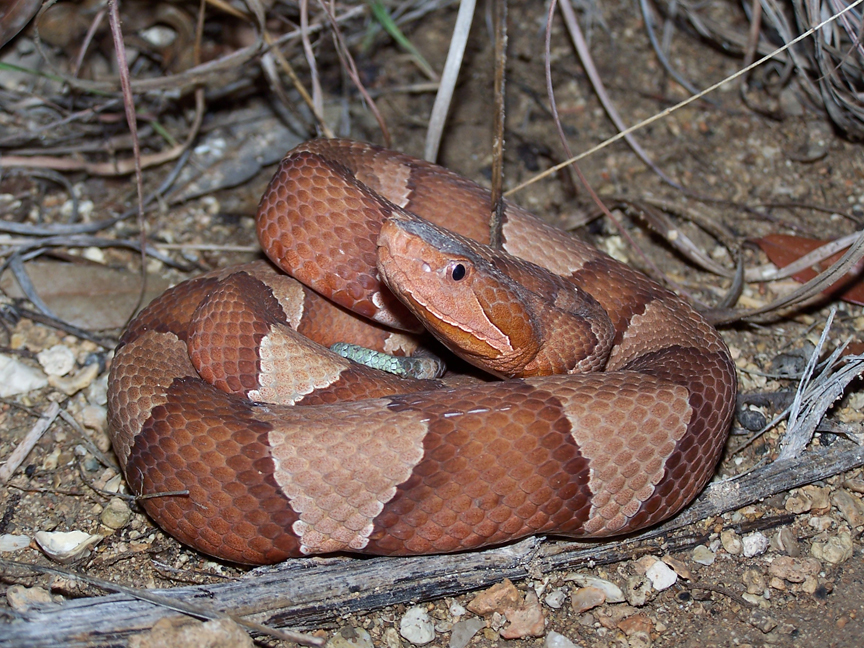
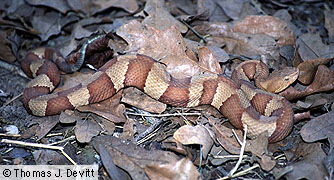
Coloration. Contrasting red (copper) or brown crossbands on a light tan background.
General distribution. In the United States, populations of Agkistrodon contortrix are found from Texas and Oklahoma in the southwest, Iowa to the northwest, New York and Massachusetts to the northeast, and Florida to the southeast. A few peripheral populations of A. contortrix are found in extreme northern Mexico.
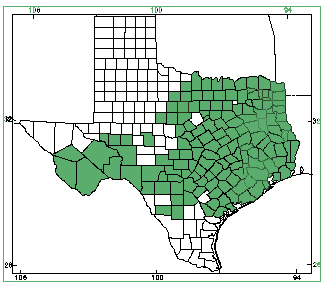
Texas distribution. Agkistrodon contortrix is found throughout most of the state, save the Panhandle and the extreme western Texas counties (El Paso, Hudspeth, Culberson).
Habitat. The Copperhead is a colorful and frequently seen snake found throughout much of the eastern half of Texas. The habitats of Copperheads do not generally include standing or running water, in fact, A. c. pictogaster can be found in relatively dry desert canyons in west Texas.
Reproduction. Copperheads may breed in April and May, giving birth to as many as eight live young in August and September, with the young snakes measuring 18-25.5 cm (7-10 in). There is also evidence that copperheads may only give birth to young every other year.
Size. Adult copperheads measure between 51-91.5 cm (20-36 in); record length is 132 cm (52 in) in A. c. contortrix.
Map. Orange counties indicate new county records since previous Herps of Texas update in 1998; all other colored counties reflect known distribution prior to 1998 for species and/or subspecies. Map is based on museum voucher specimens.